
Why our sense of smell is an under-used key for emotional regulation in the neurodivergent nervous system

You’re at work, preparing for a stressful meeting. Maybe you’re in the supermarket, and your child won’t stop crying. You miss a train, forget your keys, or get stuck in a crowded space. One minute, you’re fine.
The next? Panic, overwhelm or shutdown sets in. You might wonder where it came from, and why it suddently feels so hard to deal with the situation.
This can be all-too-familiar for people with ADHD, autism and other forms of neurodivergence.
Due to key differences in our central nervous systems, neurodivergent people often struggle to process lots information at a time. This capacity bottleneck can reduce our ability to both process and act on environmental information coming into our brains, which can lead to high anxiety and overwhelm.
How neurodivergent people process information
Autistic people may experience alexithymia, or difficulty with recognising and naming emotions, which can mean that a situation can become suddenly overwhelming as the signs of emotional heightening might be missed, in both self or others.
People with ADHD may have trouble with interoception, which relates to how we experience what is physically happening in the body. Body cues like hunger, pain, and emotions might be missed, leading to sudden states of dysregulation and overwhelm. This can also happen with other forms of neurodivergence.
So, what might be a manageable situation can quickly become untenable and distressing for neurodivergent folks.
Physical brain differences in neurodivergent people are responsible for these ways of processing the world. Studies on ADHD brains show brain differences in executive functioning, which regulates our attention, behaviour and emotions - which is why it’s regularly a challenge for ADHDers to manage these.
Some research shows that autistic people have a larger amygdala, which is the emotion and fear centre of the brain. However, there is less connection between the brain areas involved in emotional regulation, meaning that emotions can feel more intense and much harder to regulate for autistic people.
There can be feelings of shame and despair after a distressing episode. But I hope that knowing that regulation is much harder for you, and that this evidence is backed up by research, will help you feel less shame about the challenges you experience, They are often beyond your control and are not your fault.
So, what can you do when overwhelm strikes?

It can be hard to know what to do when you’re out and about and you feel overwhelmed, go into meltdown, or shut down completely.
Often, we just want to go home and be on our own, in a safe place.
It can also be difficult for others to know how to support us if going home or moving somewhere quiet isn’t an option.
Thankfully, there are a number of simple, easy-to-use and inexpensive tools we can draw on to support us when we encounter a distressing situation.
Our sense of smell is one of the most powerful ones.
Yes, really.
How our sense of smell regulates our emotions
Our nervous system is very sensitive to scent.
In fact, our sense of smell is the only sense with a direct link to our brain.
Inhaling aromas means they enter our bloodstream and central nervous system, where they can trigger the release or inhibition of certain hormones into the bloodstream. These hormones can activate or inhibit our parasympathetic (our ‘rest and digest’ mode) or trigger our sympathetic nervous systems (‘fight/flight/freeze’) response.
When we detect an aroma, the limbic system, a collection of structures in our brain that includes the thalamus, hypothalamus and amygdala. The amygdala in particular, the first port of call for odours reaching the brain, is concerned with interpreting the ‘emotional significance of events in the external world'‘, as we saw above, comes into play. The hypothalamus, another part of our brain’s limbic system, is responsible for the release or inhibition of other hormones, including dopamine, the ‘feel-good’ or ‘pleasure’ hormone. Since the hypothalamus is the area where the nervous system and endocrine (hormonal) systems collide, inhaling scents can impact on anything from our mood, to our sleep and metabolism.
Aromas are not always consciously processed by the brain’s frontal cortex, where our usual cognition and interpretation occurs, meaning that we don’t always consciously recognise the influence aromas have on our body and mind.
Why aromatherapy is the missing piece in emotional regulation
Aromatherapy means using aromatic herbal extracts like essential oils and aromatic waters for therapeutic effect.
It’s not just ‘nice smells’. It’s scientifically proven to have beneficial effects on the body and mind. And it works quickly.
Thanks to this direct link to the brain and an aroma’s ability to influence our nervous system, aromatherapy is extremely helpful for emotional regulation and wellbeing. And inhaling essential oils is the fastest and most direct route to influencing our mood.
I’ve seen this with my clients in my aromatherapy and herbal medicine clinics, and I’ve experienced it for myself. And the research backs it up. So it stands to reason that inhalation is the most commonly-used method by aromatherapists trying to produce - or reduce - a certain emotional state.
Inhaler sticks are incredibly easy and enjoyable to use, and I’ve found them to be very effective in supporting my patients who need an instant anchor to help ground them when things become too much.
Which scents should I use?
Certain plant aromas work particularly well for neurodivergent brains.
Some are particularly calming. Some actually increase blood flow to the pre-frontal cortex, improving focus, memory and concentration. Some help us to feel clearer-headed and more energised. Some help us sleep.
Chamomile, rosemary, bergamot and lavender are some of the most commonly-used essential oils in my clinic.
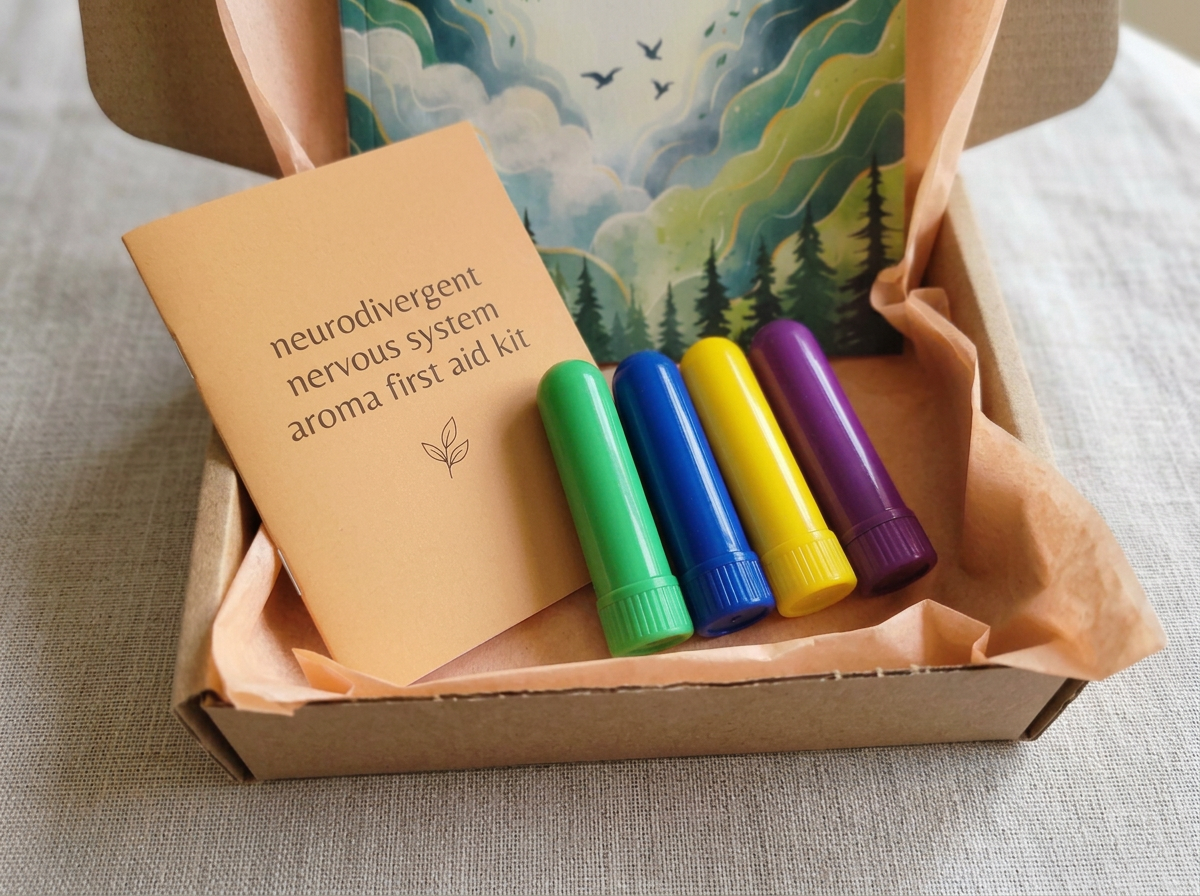
I’ve developed an aromatic first-aid kit with these oils, specifically designed for people with sensitive or neurodivergent nervous systems.
The kit comes with instructions on how to make the most of it, and four refillable inhalers which you can keep in your pocket or to hand when things simply get too much.
Inhalers can also work really well as a preventative measure when stress creeps up and you want to avoid a difficult experience.
Try it out and get 10% off with code BLOG10.
Orders ship the first week of November.
Note: Hyperosmia, the heightened scent-sensitivity experienced by many neurodivergent people, can be really helpful when using scent to calm the nervous system, and make the experience of smelling aromas a much richer and deeper one. But it’s worth noting that some people may dislike certain aromas, and be extra-sensitive to smells, so care should be taken to make sure that whichever scent you’re using, you find it calming or pleasant.
-
Book: The Healing Power of Scent, Ellen Rowland, 2024.
https://thepolyphony.org/2023/06/13/olfactory-overload-knowing-the-neurodivergent-nose/
https://www.theneurodiversitypractice.com/blog/emotional-regulation?srsltid=AU7gw4VNwecskoHhhH4YOMzo3OPs3bN-MiJp4Oe2agBxixng0QRE2fyy
https://pmc.ncbi.nlm.nih.gov/articles/PMC6996017/
https://www.leicspart.nhs.uk/autism-space/health-and-lifestyle/meltdowns-and-shutdowns/